
Why is the ground floor of an HDB block empty?
Posted
Watch it
Video script
HDB blocks used to have flats on the ground floor. And those were the flats people wanted, because many were afraid of lifts.
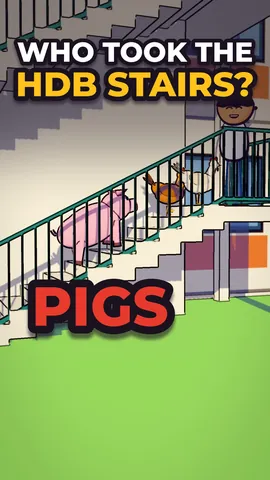
Many of the first residents came from kampongs, and a ground-floor flat opened straight onto the ground. Some even brought their pigs and poultry along, and taught them to climb the stairs.
The lifts were new, and they broke down. As late as 1978, the average HDB lift broke down more than once a month. Older people living high up felt trapped at home.
And back then, a ground-floor flat cost exactly the same as one at the top.
It turns out living at the bottom had problems. There was little privacy, the air barely moved, and the rubbish chutes were close by. So from 1973, HDB left the ground floor open. That empty floor is the void deck.
Then the lifts got better. In 1988, HDB started pricing flats by floor. Nine years later, a minister told Parliament that owners used to prefer lower floors, but now paid more to live high, for the view and the privacy.
In 2025, in the same block, the top floors resold for about nine percent more per square metre than the bottom three.
Next, why every building in Singapore got its own six-digit code.
Every fact, with its source (17)
17 facts. Tap a source to read it yourself.
In HDB's early years, ground-floor flats were sought after because they gave direct access to the outdoors, and they were popular with people who were afraid of taking lifts.
Many people who moved into HDB flats in the early 1960s had been resettled from kampongs, where, in former HDB architect Alan Choe's words, "you grow your chickens, you grow everything".
Some resettled residents brought pigs and poultry from their kampong to their new flats and taught the animals to climb the stairs.
Elderly people living on higher floors felt "trapped" in their flats because they dared not use the lifts for fear of breakdowns.
In 1978, HDB's lifts broke down 1.18 times per lift per month on average, with 97,700 lift complaints that year; by 1982 (to October) the rate was 0.83, with 5,518 lifts in HDB estates.
In 1974 there were 1,350 lifts in HDB estates.
HDB blocks built before the mid-1990s mostly did not have a lift landing on every floor; HDB says lifts stopped only at certain floors to save land and build faster.
- Hansard, 27 Feb 2024, "Installation of Stair Lifts or Escalators or Redevelopment for HDB Blocks without Direct Lift Access", Desmond Lee (via Telescope) telescope.gov.sg
- CNA, "The daily pains and extra costs of living in an HDB block where lifts cannot be upgraded" (Deborah Lau, 11 Apr 2025; HDB's statements to CNA) channelnewsasia.com
In 1970, HDB already gave applicants with conditions such as paralysis or heart disease special consideration for ground- and first-floor flats.
HDB's early flats were sold at fixed prices: flats of the same type in a block were priced the same whatever the floor, and buyers were allocated units by ballot. The fixed pricing ended in 1987.
Ground-floor flats lost favour with buyers because they had little privacy and poor ventilation; some residents also felt they were too close to the rubbish chutes.
HDB's 1969 annual report set out to keep ground floors free of flats; from 1973 an open ground floor became the norm.
From 1988, HDB priced new flats with premiums and discounts for each flat's attributes, including storey height ("Differential Pricing Policy").
On 11 July 1997, the Minister for National Development told Parliament that higher-floor flats generally command higher value, that "This was not always the case. In the past, owners preferred lower floors", and that as lifts became more reliable and owners preferred the view and privacy of higher floors, such flats commanded a premium.
In 1989 the government told Parliament that HDB was building new blocks with lifts on every floor; in 2024 it said blocks built since the mid-1990s have direct lift access on every floor.
HDB launched the Lift Upgrading Programme in 2001 and has done it in more than 5,000 blocks; about 99 percent of blocks now have direct lift access on every floor.
In 2025, 25,084 HDB resale flats were registered. In the 1,463 groups of the same block and flat type that sold flats on floors 1 to 3 and on a floor band from 10 up, the highest band sold for a median 9.1 percent more per square metre than floors 1 to 3 (mean 9.6 percent).
- data.gov.sg, "Resale flat prices based on registration date from Jan-2017 onwards" (Housing & Development Board, d_8b84c4ee58e3cfc0ece0d773c8ca6abc), twelve pulls filtered by month 2025-01 to 2025-12, retrieved 2026-11-17 data.gov.sg
- Our own arithmetic on the figures and dates above
1988 to 1997 is nine years. 1.18 breakdowns a month is more than once a month.
- Our own arithmetic on the figures and dates above
More sources (4)
- sgparliament.com Hansard, 14 Jun 1978, "Housing and Development Board Flats (Employment of lift attendants)", Lim Kim San (sgparliament.com)
- sgparliament.com Hansard, 29 Mar 1989, "Commonwealth Crescent (Conversion of old ground floor rental units into void decks)", Dr Lee Boon Yang (sgparliament.com)
- sgparliament.com Hansard, 14 Oct 2020, "Ratio of Total Number of Dwelling Units to Pavilions and Total Number of Void Decks to Blocks in Current and New HDB Developments", Desmond Lee (sgparliament.com)
- mothership.sg Mothership, "The story behind when the 'void deck' was introduced and how it was invented" (Martino Tan, 27 Dec 2016)
Corrections
No corrections so far. Any correction to this video is logged here, with its date.