Why does Singapore's postal code have six digits?
Posted
Watch it
Video script
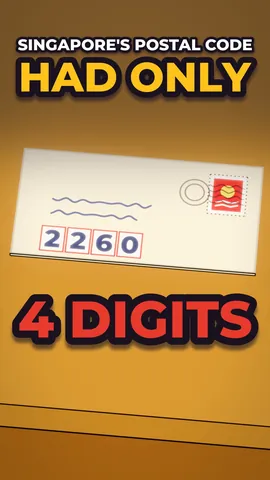
In 1993, Singapore's postal code had only four digits. That meant room for 10,000 codes, but we had a big problem. There were about 270,000 addresses.
The four-digit code dated from 1979. Machines could sort mail by area, but no further. After that, every postman sorted his own letters by hand, in delivery order.
Mail kept growing. In 1993, a minister told Parliament that if sorting stayed by hand, the post would need about 600 more postmen by 2000. His answer was to give every address its own code. That needed six digits.
So in September 1995, sixteen years after the four-digit code, Singapore switched to six. The first two digits kept the old area. Zero one is the city. Fifty-two, Tampines. Sixty, Jurong. The last four point to one building.
If you live in an HDB flat, look at your postal code. It ends in your block number.
Next, the Merlion, and why it's younger than you think.
Every fact, with its source (28)
28 facts. Tap a source to read it yourself.
Singapore's first postal codes came in 1950: two digits, for 28 postal districts.
- NLB Infopedia, "Six-digit postal code system" (Joshua Chia; valid as at 13 July 2016; cites Business Times 18 Feb 1992, Straits Times 15 Feb 1994 and 12 Sep 1998, Singapore Monitor 27 Apr 1983, and SingPost annual reports 1997 to 1999) nlb.gov.sg
- SingPost 160, "Milestones" 160.singpost.com
- SingPost Philately, "6-Digit Postal Code" stamp issue, 1 Sep 1995 philately.singpost.com
The four-digit code replaced it in July 1979. The first two digits gave the district and the last two a sector within it.
- NLB Infopedia, "Six-digit postal code system" (Joshua Chia; valid as at 13 July 2016; cites Business Times 18 Feb 1992, Straits Times 15 Feb 1994 and 12 Sep 1998, Singapore Monitor 27 Apr 1983, and SingPost annual reports 1997 to 1999) nlb.gov.sg
- SingPost Philately, "6-Digit Postal Code" stamp issue, 1 Sep 1995 philately.singpost.com
Under the four-digit code, machines sorted mail to delivery centres by sector; after that, mail was sorted by hand to each postman's beat, and the postman sorted his own mail by street and block into the order he would deliver it.
- Hansard, 18 Mar 1993, "New Postcode (Introduction)", Mah Bow Tan answering Heng Chiang Meng (sgparliament.com) sgparliament.com
- NLB Infopedia, "Six-digit postal code system" (Joshua Chia; valid as at 13 July 2016; cites Business Times 18 Feb 1992, Straits Times 15 Feb 1994 and 12 Sep 1998, Singapore Monitor 27 Apr 1983, and SingPost annual reports 1997 to 1999) nlb.gov.sg
A postman could spend up to two hours sorting his mail into delivery order before going out. (SingPost's account, written in 1998, about the step the new machines removed.)
Under the four-digit code, 48 percent of mail was sorted by hand; the six-digit code cut that to 17 percent.
On 18 March 1993, the Minister for Communications, Mah Bow Tan, told Parliament the Postal Service handled about 1.6 million articles a day, growing about 6 percent a year, and would need about 600 more postmen by 2000 if sorting stayed manual.
In the same answer, he said each of Singapore's 270,000 addresses, or groups of addresses in one block, should get its own code so mail could be sorted automatically into the postman's order of delivery; that needed at least six digits, because four digits can only make 10,000 codes.
The six-digit postal code started on 1 September 1995.
- NLB Infopedia, "Six-digit postal code system" (Joshua Chia; valid as at 13 July 2016; cites Business Times 18 Feb 1992, Straits Times 15 Feb 1994 and 12 Sep 1998, Singapore Monitor 27 Apr 1983, and SingPost annual reports 1997 to 1999) nlb.gov.sg
- SingPost Philately, "6-Digit Postal Code" stamp issue, 1 Sep 1995 philately.singpost.com
- Universal Postal Union, addressing sheet "Singapore" (07/2009) upu.int
1979 to 1995 is sixteen years; September 1995 to September 1998 is three years.
- Our own arithmetic on the figures and dates above
The first two digits of a six-digit code are the old sector (the last two digits of the four-digit code); the last four name one delivery point: a house, a building or a block of flats.
- NLB Infopedia, "Six-digit postal code system" (Joshua Chia; valid as at 13 July 2016; cites Business Times 18 Feb 1992, Straits Times 15 Feb 1994 and 12 Sep 1998, Singapore Monitor 27 Apr 1983, and SingPost annual reports 1997 to 1999) nlb.gov.sg
- Universal Postal Union, addressing sheet "Singapore" (07/2009) upu.int
- SingPost Philately, "Sorting the Mail - A History of Singapore Post" (extract from Keylines, SingTel Group; page dated 1 Sep 1995, text written after the Sep 1998 move to Eunos) philately.singpost.com
The first two digits of a six-digit code are the postal sector. URA's list (source: SingPost) groups 81 sectors into 28 postal districts. Examples: 01 to 06 is Raffles Place, Cecil, Marina and People's Park; 22 and 23 are Orchard, Cairnhill and River Valley; 51 and 52 are Tampines and Pasir Ris; 56 and 57 are Bishan and Ang Mo Kio; 60 to 64 are Jurong.
52 is Tampines: Blk 147 Tampines Avenue 5 is 521147 and Blk 147 Simei Street 2 is 520147.
The sectors don't run in map order: Telok Blangah and Harbourfront are 09 and 10, Queenstown is 14 to 16; 81 belongs to Changi's district and 82 to Punggol's; there is no sector 74.
"District 9, 10, 11" in property talk are postal districts: 9 is sectors 22-23 (Orchard), 10 is 24-27 (Bukit Timah, Tanglin), 11 is 28-30 (Novena, Thomson).
Blk 201 Jurong East Street 21 (Jurong East View) is 600201: sector 60, Jurong, and the block number in the last digits. Checked on OneMap 2026-11-18, one result, lat 1.3364, lon 103.7431.
The four-digit example is 2260: district 22 (Jurong) and sector 60, the old code this Jurong block would have had under the four-digit system (inference: districts and sectors from URA's current list, which SingPost says keeps the 1979 sectors; not checked against a 1979 directory).
- URA, List of Postal Districts (source: SingPost), PDF via go.gov.sg go.gov.sg
- inference
For an HDB residential block, the delivery point is the block number; private houses and other buildings are numbered in the alphabetical order of their street names within the sector.
Examples checked on OneMap: Blk 147 Simei Street 2 is 520147, Blk 147 Tampines Avenue 5 is 521147 (same sector, same block number, codes one digit apart), and Blk 145 Lorong 2 Toa Payoh is 310145. Each search returned exactly one result with its coordinates.
In September 1998, SingPost moved mail sorting from Chai Chee to the Singapore Post Centre on Eunos Road 8, where machines sort by the six-digit code and stack mail in delivery order on trays for the postmen.
- NLB Infopedia, "Six-digit postal code system" (Joshua Chia; valid as at 13 July 2016; cites Business Times 18 Feb 1992, Straits Times 15 Feb 1994 and 12 Sep 1998, Singapore Monitor 27 Apr 1983, and SingPost annual reports 1997 to 1999) nlb.gov.sg
- SingPost Philately, "Sorting the Mail - A History of Singapore Post" (extract from Keylines, SingTel Group; page dated 1 Sep 1995, text written after the Sep 1998 move to Eunos) philately.singpost.com
The new code could make one million codes; the four-digit code could make 10,000.
- NLB Infopedia, "Six-digit postal code system" (Joshua Chia; valid as at 13 July 2016; cites Business Times 18 Feb 1992, Straits Times 15 Feb 1994 and 12 Sep 1998, Singapore Monitor 27 Apr 1983, and SingPost annual reports 1997 to 1999) nlb.gov.sg
- Hansard, 18 Mar 1993, "New Postcode (Introduction)", Mah Bow Tan answering Heng Chiang Meng (sgparliament.com) sgparliament.com
On 27 September 1995, the minister told Parliament that 108,000 six-digit codes were in use, that about 360,000 would be needed by 2030, and that he did not foresee a need for eight digits.
The six-digit code is still Singapore's postal code today. [general knowledge; onemap-search]
- No source given
Use of the new code rose slowly: about 85 percent of mail carried it by end March 1997, 96.3 percent a year later, and 98 percent by 31 March 1999.
Postal articles handled rose every year from 1979 to 1995, and 1993's total was 2.7 times 1979's.
- Our own arithmetic on the figures and dates above
- data.gov.sg, "Postal Articles Handled, Annual" (Singapore Department of Statistics, d_5bd9b4d75e5aa7100ab5235fcb14b32d), retrieved 2026-11-18 data.gov.sg
Singapore's post handled 1,245,124 thousand postal articles in 1995 and 720,396 thousand in 2025.
So 2025's volume was about 58 percent of 1995's: less mail than in the year the six-digit code began.
- Our own arithmetic on the figures and dates above
- data.gov.sg, "Postal Articles Handled, Annual" (Singapore Department of Statistics, d_5bd9b4d75e5aa7100ab5235fcb14b32d), retrieved 2026-11-18 data.gov.sg
Volume peaked in 2011 at 2,085,495 thousand articles; 2025 was about 35 percent of that peak, and the lowest since 1987 (685,220 thousand).
- Our own arithmetic on the figures and dates above
- data.gov.sg, "Postal Articles Handled, Annual" (Singapore Department of Statistics, d_5bd9b4d75e5aa7100ab5235fcb14b32d), retrieved 2026-11-18 data.gov.sg
The Merlion was created as a tourism board emblem in 1964, and the statue was unveiled on 15 September 1972.
- Roots.gov.sg, "Celebrating 50 years of the Merlion" roots.gov.sg
Corrections
No corrections so far. Any correction to this video is logged here, with its date.