Why were long-haired men served last in Singapore?
Posted
Watch it
Video script
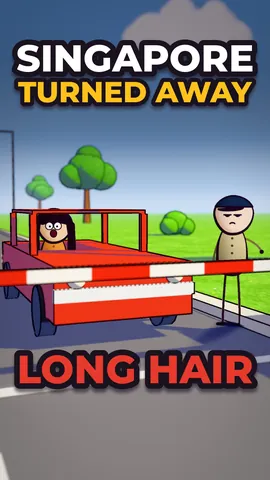
In 1970s Singapore, long hair could get a man sent to the back of every government queue, turned away at the border, or sacked from his job. Why was a government this worried about hair?
In September 1970, Lee Kuan Yew was asked what problems Singapore had to solve next. He named the economy first. Second was hippie culture, "spreading across the jet routes" with songs and films "tending towards escapism and the taking of drugs".
So the government went after the look. Sixteen months later, in January 1972, Operation Snip Snip began, and long-haired men were refused entry unless they got a haircut. One barber near the Woodlands checkpoint said he had never had such business in twenty years. He put his price up by thirty cents.
Five months later, in June, posters went up in every government office that dealt with the public, saying males with long hair would be attended to last. Civil servants who kept theirs long could lose their jobs.
That August, Cliff Richard cancelled all three of his Singapore concerts, because he and his band wouldn't cut their hair.
Eight months later, he landed in Singapore anyway, hair still long. They let him in, for one night, on his way to Australia.
Every fact, with its source (10)
10 facts. Tap a source to read it yourself.
From June 1972, all government offices that dealt with the public put up posters in English, Chinese and Malay saying "Males with long hair will be attended to last". The Ministry of Home Affairs announced it on 22 June 1972.
- The Straits Times, 23 June 1972, p. 8, "Long hair means a long, long wait... End of the queue at govt offices" (NewspaperSG issue listing) eresources.nlb.gov.sg
- NLB Infopedia, "Campaign against yellow culture is launched" nlb.gov.sg
- BiblioAsia, "Singapore's Hippie Hysteria and the Ban on Long Hair" (Apr 2024), with Straits Times and New Nation citations for each fact biblioasia.nlb.gov.sg
Male civil servants were warned that long hair was a disciplinary offence that could lead to dismissal. By the end of 1973 more than 4,000 had been warned, and five who kept their hair long were dismissed. Since May 1973 every government department had an officer enforcing "the policy that males with long hair will be attended to last".
On 18 September 1970, Lee Kuan Yew was asked what problems Singapore had to solve next. He named economic viability first. The second was "the 'hippie' culture which is spreading across the jet routes", with songs, TV, films and magazines "tending towards escapism and the taking of drugs".
The government attacked long hair as "one of the symbols to which hippies attach great importance". Foreign Minister S. Rajaratnam said it was "hippieism not hair style" it was attacking (New Nation, 31 Jan 1972). The Minister for Home Affairs called hippie dress and long hair "outward manifestations of a state of mind that may lead a person eventually to being hooked on drugs".
The Ministry of Home Affairs started Operation Snip Snip in January 1972. Long-haired men were refused entry unless they got a haircut.
By 9 January 1972, more than 500 people with long hair were said to have been turned back at the Woodlands immigration checkpoint and told to get a haircut; most used a barber stall 50 yards from the checkpoint.
A barber near the Woodlands checkpoint, M. Kandasamy, said he had never had such business in 20 years. He charged 30 cents more than the usual $1.20.
In August 1972 Cliff Richard cancelled all three of his September concerts at the National Theatre. He and his band had refused to cut their long hair.
On 13 April 1973 Cliff Richard, still with long hair, was allowed into Singapore for a one-night stopover on his way to Australia and New Zealand.
September 1970 to January 1972 is 16 months. January to June 1972 is five months. August 1972 to April 1973 is eight months.
- Our own arithmetic on the dates above
Corrections
No corrections so far. Any correction to this video is logged here, with its date.