Why did Singapore ban firecrackers?
Posted
Watch it
Video script
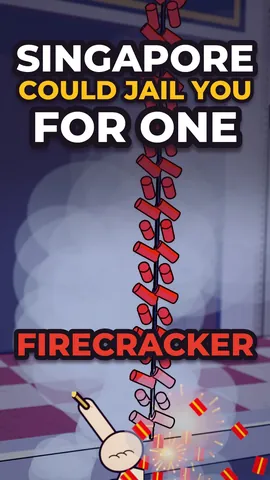
Chingay, Singapore's biggest street parade, began because of a ban on firecrackers. It turns out the government didn't want to ban them, even after six people died.
In 1970, Chinese New Year meant firecrackers. On Chap Goh Meh, the fifteenth night, people hung strings of crackers several storeys long and lit them from the bottom. Shop owners held cracker wars to see whose string burned the longest.
That night, the 20th of February, crackers exploded in three separate places, and six people died.
Just over five weeks later, Parliament rushed through a law, and firing crackers now needed a police permit. But the minister said the government did not want a total ban, so for the next two Chinese New Years, adults could still fire crackers in open spaces the police picked.
People kept firing them everywhere else. On Chinese New Year's Eve in 1972, two unarmed policemen in Upper Serangoon Road tried to stop a group letting off crackers, and the group attacked them.
Five weeks after that, the government changed its mind and moved to ban firecrackers completely. From the first of August 1972, just having one could cost you up to 5,000 dollars, or two years in jail.
People weren't happy about a Chinese New Year without firecrackers. So Lee Kuan Yew suggested making up for it with a street parade like Penang's. Six months after the ban, in February 1973, 2,000 performers paraded behind two giant fake firecrackers, with lion dancers, stilt walkers and clowns with oversized heads. That was the first Chingay Parade.
Thirty-one years later, in January 2004, the government let 10,000 real firecrackers go off in Chinatown, the first legal ones in over thirty years.
Every fact, with its source (27)
27 facts. Tap a source to read it yourself.
In 1970 people let off firecrackers at Chinese New Year, and on Chap Goh Meh, the fifteenth night, long strings of crackers were "strung up several storeys high" and let off in many parts of the city, in "cracker wars".
- Hansard sgparliament.com (30 Mar 1970, Ng Kah Ting, Minor Offences (Amendment) Bill)
The long streamer type of firecracker was hung from the top of a building and lit from below.
- NLB Infopedia nlb.gov.sg ("Firecrackers")
Businessmen competed to have the longest-lasting round of firecrackers, a "cracker war", on the fifteenth night.
- SCCC Culturepaedia culturepaedia.singaporeccc.org.sg ("Firecrackers (Bianpao)")
- secondary, but from the Singapore Chinese Cultural Centre
On Chinese New Year's Eve 1972, two policemen trying to stop people letting off firecrackers without a permit in Upper Serangoon Road were attacked.
- NLB Infopedia nlb.gov.sg ("Firecrackers", citing Straits Times 11 Feb 1985)
- Hansard sgparliament.com (30 Mar 1988, "two police officers were brutally attacked by a group of men firing crackers")
- NewspaperSG eresources.nlb.gov.sg (Straits Times 22 Feb 1972 p. 13, "Attack on PCs: Another youth gives up to police", NewspaperSG issue listing)
Chinese New Year's Eve 1972 was Monday 14 February 1972.
- NewspaperSG eresources.nlb.gov.sg (Straits Times 11 Feb 1972 p. 17, "Monday (Chinese New Year Eve)", NewspaperSG issue listing)
The Dangerous Fireworks Bill was read the first time on 21 March 1972, five weeks after that eve. (Hansard, 21 Mar 1972; SSO, Bill No. 20/1972) It prohibited keeping, possessing or letting off dangerous fireworks, with a fine of up to S$5,000 or up to two years in jail, or both. (SSO, Bill 20/1972, ss 3 and 5) Parliament passed it on 2 June 1972.
- Hansard sgparliament.com (30 Mar 1988)
- NLB Infopedia nlb.gov.sg (NLB Infopedia "Chingay", citing Straits Times 3 Jun 1972)
The Act came into operation on 1 August 1972.
- NLB Infopedia nlb.gov.sg ("Regulating the Use of Fireworks", citing the commencement notification Sp.S 202/1972)
- Straits Times eresources.nlb.gov.sg (9 Nov 2018, "4 men charged over illegal fireworks", "A total ban was rolled out on Aug 1, 1972")
With no firecrackers, Lunar New Year 1973 caused "unhappiness and reduced public enthusiasm"; the festivities became "less lively and boisterous".
- NLB Infopedia nlb.gov.sg ("Chingay")
- BiblioAsia biblioasia.nlb.gov.sg ("Chingay in the 19th and 20th Centuries", 2025)
Lee Kuan Yew, then Prime Minister and chairman of the People's Association, suggested a Chingay parade like Penang's.
- NLB Infopedia nlb.gov.sg (NLB Infopedia "Chingay", citing the People's Association commemorative book)
- BiblioAsia biblioasia.nlb.gov.sg (BiblioAsia 2025)
- chingay.gov.sg chingay.gov.sg ("The Chingay Story")
The first formally organised Chingay Parade was held on 4 February 1973 with about 2,000 performers, including lion dancers, stilt walkers, jugglers and clowns in costumes with oversized heads. It was led by a statue of a bull (Year of the Ox) and two giant ornamental firecrackers.
- NLB Infopedia nlb.gov.sg (NLB Infopedia "Chingay")
- National Archives of Singapore corporate.nas.gov.sg ("The First Chingay Street Parade, 1973")
- Chingay Parade chingay.gov.sg (chingay.gov.sg, "the first formal Chingay Parade")
Chingay processions also ran in Singapore from the 1880s until clans abolished them in 1906, so 1973 was the first Chingay Parade, not the first chingay.
- NLB Infopedia nlb.gov.sg (NLB Infopedia "Chingay")
1 August 1972 to 4 February 1973 is six months.
- Arithmetic
On 3 January 2004, 10,000 firecrackers went off in Chinatown for five minutes, "a sound unheard in Singapore for 30 years".
- NewspaperSG eresources.nlb.gov.sg (Straits Times, 4 Jan 2004, p. 1, "Boom, boom, shake off the gloom", NewspaperSG issue listing)
February 1973 to January 2004 is 30 years 11 months ("thirty-one years later"); August 1972 to January 2004 is 31 years 5 months ("over thirty years").
- Arithmetic
20 February to 30 March 1970 is 38 days ("just over five weeks"); 14 February to 21 March 1972 is 36 days ("five weeks").
- Arithmetic on the dates above
Chinese New Year 1973 fell on 3 February 1973, the day before the first Chingay Parade.
- General knowledge, not sourced
Chingay is "said to be the largest street performance and float parade in Asia" (National Archives of Singapore, 2015) and "one of Asia's largest street performance and float parade".
- chingay.gov.sg chingay.gov.sg
The parade "began because of" the ban: it was suggested as an alternative after the ban took the fun out of Lunar New Year (NLB Infopedia "Chingay") and "compensated for the ban on firecrackers".
- chingay.gov.sg chingay.gov.sg
More sources (10)
- sgparliament.com Hansard, 30 Mar 1970, "Minor Offences (Amendment) Bill"
- sgparliament.com Hansard, 21 Mar 1972, "Dangerous Fireworks Bill" (first reading)
- sgparliament.com Hansard, 30 Mar 1988, "Dangerous Fireworks (Amendment) Bill"
- sso.agc.gov.sg Singapore Statutes Online, Dangerous Fireworks Bill, Bill No. 20/1972
- eresources.nlb.gov.sg NLB Infopedia, "Regulating the Use of Fireworks"
- nlb.gov.sg NLB Infopedia, "Chingay"
- eresources.nlb.gov.sg NewspaperSG, Straits Times 22 Feb 1972 (issue listing)
- straitstimes.com The Straits Times, "4 men charged over illegal fireworks" (9 Nov 2018)
- eresources.nlb.gov.sg NewspaperSG, Straits Times 4 Jan 2004 (issue listing)
- zaobao.com.sg Lianhe Zaobao, 13 Dec 2023 (Chinese)
Corrections
No corrections so far. Any correction to this video is logged here, with its date.